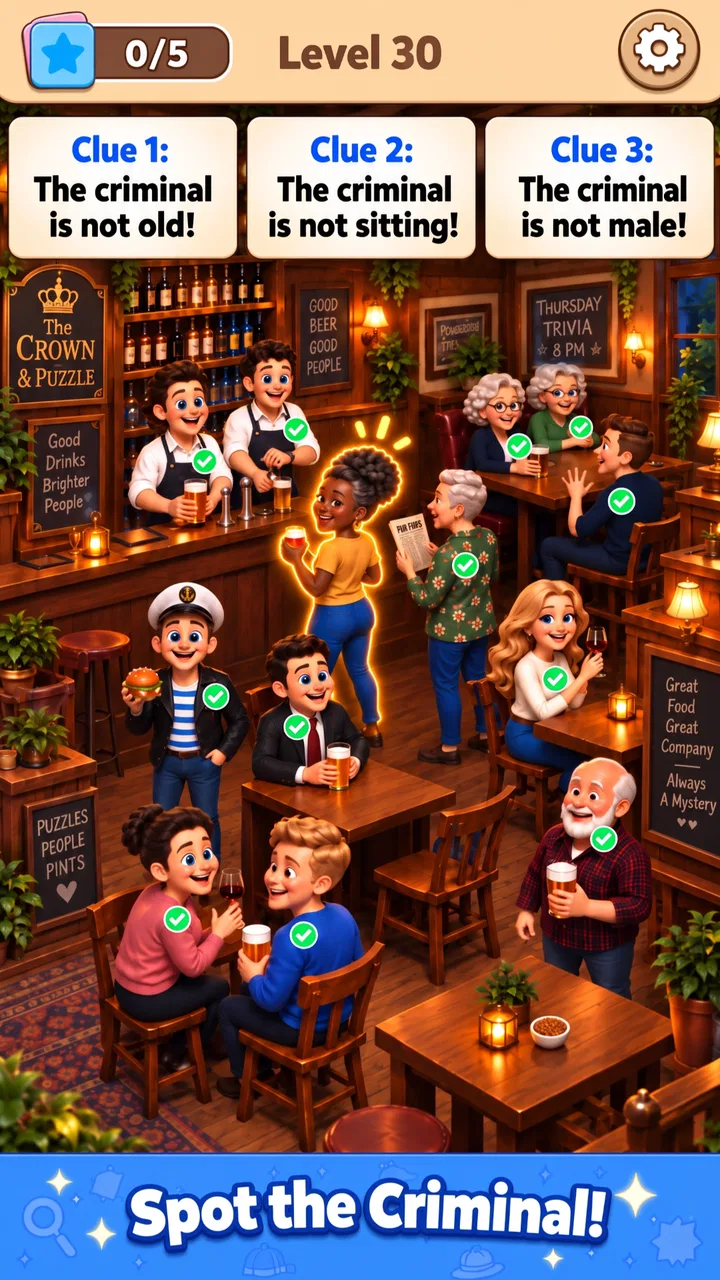
Connect Master - Match Puzzle
- 4.8
- Rating
- 1.00M
- Installs
- Free
- Price

 Analysis by App-foxy
I picked up Connect Master - Match Puzzle expecting a light matching game, but its appeal is a little more thoughtful than that. The basic idea is to search for relationships between items, swap where needed, and complete the hidden connections. It is easy to understand within a few moments, yet the better puzzles ask me to slow down instead of tapping at random. That makes it a pleasant choice for short breaks, especially when I want something more engaging than an endless stream of identical matches.
Developed by Rooftop Game, this free puzzle game is aimed at Everyone and works on Android 7.0 or later. It has reached over a million installs and holds a 4.7 average from around thirteen thousand ratings, which gives a useful indication of its broad appeal without telling the whole story. I found the experience most enjoyable when I treated it as a small reasoning exercise rather than a game to rush through. The current version is 2.6.0, and the core attraction remains the same: spotting the connection that is not immediately obvious.
How Connect Master fits into a shared household
The first thing I noticed is how naturally this type of puzzle fits around ordinary household routines. One person can play while waiting for the kettle, another can take over during a quiet moment, and nobody needs a long uninterrupted session to get value from it. Because each challenge is based on visual searching and matching, it is also easy for someone nearby to look over and offer an idea without needing a full explanation of complicated controls.
You May Also Like

 Blood Strike: 2.5 Anniversary
Blood Strike’s Loadouts Turn Every Drop Into a Tactical Gamble
A close look at Blood Strike’s custom loadouts: how fast access to signature weapons reshapes its battle royale rhythm, rewards preparation, and narrows the gap between fights.

 Pandora - Music & Podcasts
Pandora’s Music Is Easy to Start, but Harder to Recover
Pandora’s strength is its low-effort path from a seed to a station. Its weak spot is how much confidence it asks you to place in connection, setup, and quiet recovery.

 8 Ball Pool
 Is Built on Rivalries, Rematches, and Routine
A close look at the rivalries, rematches, shared routines, and unanswered safety questions that turn a quick pool match into a persistent mobile community.

 Samsung Music
’s Quiet Strength Is Playing What You Already Own
Its reach comes less from spectacle than from dependable access to a personal library. That simplicity is both the app’s strongest retention engine and its ceiling.

 AccuWeather: Weather Radar
AccuWeather Review: A Quick, Clear Forecast for Everyday Decisions
For everyday plans, the best forecast is the one you can understand quickly. AccuWeather makes rain timing, radar, and local conditions easy to act on, with a few trade-offs.

 Hill Climb Racing
Why Hill Climb Racing Still Turns Crashes Into One More Run
A tiny car, a bumpy hill and one more upgrade: Hill Climb Racing keeps resurfacing because its simple chaos makes every near-miss feel personal.
More From Our News Desk



That makes it more suitable for shared-device use than many competitive puzzle games. A parent, partner, or child can hand over the phone and say, “What do you think belongs together?” The other person can then contribute without needing to understand a large map, a character upgrade system, or a long-running account. I enjoyed this informal back-and-forth because the puzzle becomes a small conversation rather than a solitary reflex test.
There is an important distinction, though. Shared play is not the same as shared progress. I would not treat the game as a family profile or a managed multiplayer experience. The practical approach is to regard the device as the shared space and the game session as belonging to whoever is currently holding it. If several people want to play, agreeing on turns before starting avoids the usual argument over who changed the current puzzle.
A useful routine for short sessions
My preferred household routine is simple: one person searches for possible pairs, the other checks whether the relationship really makes sense, and the person holding the phone makes the final move. This division is surprisingly effective. It prevents the quickest tapper from taking over every decision, while still keeping the game moving. It also reveals whether a puzzle is genuinely clear or whether we are forcing a connection because we want to finish quickly.
For a solo player, the same method can be used mentally. I first scan the entire board, then group items by obvious similarities, and only after that begin swapping or matching. The temptation is to act on the first pair that looks plausible. In my experience, that is where mistakes and unnecessary hesitation begin. A full-board scan gives me a better sense of the puzzle’s structure and makes the eventual solution feel earned.
This is one of the game’s less visible strengths: it rewards observation before action. Many familiar match games encourage rapid chains, timed reactions, or repeated tapping until something works. Here, I get more from pausing for a few seconds and asking what the puzzle is trying to make me notice. That makes it a better fit for a calm break than for someone looking for fast arcade energy.
What to settle before sharing the device
Before I let someone else use a shared phone for this game, I would establish a few boundaries. The most important is whether the current puzzle can be changed freely or whether everyone should finish a turn before passing the device. The game is free to download, but it includes optional in-app purchases ranging from $0.99 to $99.99 per item. That makes a household conversation about purchases sensible, particularly when children use the same device.
I would also separate “playing together” from “letting someone browse freely.” A child who is allowed to solve a puzzle may not automatically understand that purchase screens are different from game controls. The safest household habit is to keep the device’s normal purchase approval process under the account holder’s control and make it clear that no transaction is part of ordinary play. I am not presenting that as a special feature of Connect Master; it is simply good practice whenever a free game offers optional purchases.
Another useful boundary is deciding whether hints, retries, or other available actions should be used immediately or saved for genuine difficulty. I found that the game is more satisfying when I first discuss a puzzle and only then consider assistance. If a shared player taps through every obstacle at once, the household loses the small reasoning exercise that makes this title worth passing around.
Coordinating turns without turning it into a competition
Connect Master works best in a household when players coordinate rather than compete for speed. I would give each person a clear role: scanner, idea-checker, or decision-maker. These roles can rotate from puzzle to puzzle. That approach is especially helpful when one player is visually quick but another is better at noticing category relationships. It gives both people a reason to stay involved.
There is also a practical benefit to verbalizing the reasoning. Saying “these belong together because they share this idea” is more useful than simply moving pieces and waiting for the result. If the move fails, the group can reconsider the assumption instead of blaming the person who tapped. I found this turns a potentially frustrating mistake into a discussion about how the puzzle is constructed.
For siblings or friends sharing a device, I would avoid keeping a running score unless everyone genuinely enjoys that. The game’s strongest social quality is collaborative discovery, not a race to prove who reacts fastest. A player who needs more time can still make the decisive observation, and a player who usually finishes puzzle games quickly may enjoy explaining the pattern instead of rushing ahead.
This coordination also answers a common practical question: is it suitable for two people sitting together? Yes, as an informal cooperative activity, but not as a dedicated two-player mode. The experience I had was based on passing the device and discussing choices, so expectations should remain modest. It is a shared puzzle, not a structured multiplayer session with separate turns, profiles, or a built-in team system.
Age context and trust on a family device
The Everyone rating makes the game approachable for a wide household audience. The visual puzzle format is less intimidating than a game built around combat, frightening scenes, or complex social interaction. I could imagine an older child solving alongside an adult, with the adult helping explain why a connection works rather than simply giving away the answer.
Still, an age label should not replace supervision or common sense. The main household issue here is not the puzzle theme; it is the presence of optional purchases in a free game. If a child uses a parent’s phone, I would explain the difference between a normal tap that advances play and a purchase confirmation. I would also make sure the child knows that asking before buying is part of the family rule, not something to decide in the middle of a puzzle.
Trust matters in another way too. If several people use the same device, the current state of the game may be altered without anyone intending to cause trouble. I would ask younger players to leave a puzzle in place when they stop and tell the next person what they were considering. That small habit protects the shared experience better than assuming everybody will remember exactly where they left off.
For adults who want a private, uninterrupted puzzle routine, a shared family phone may be less convenient. Someone else can pick up the device, change the current situation, or interrupt a carefully considered attempt. In that case, a personal device or a clearly agreed play window is better. The game is friendly to shared use, but it cannot solve household scheduling or account separation on its own.
Why its puzzle style feels different from ordinary match games
Compared with classic tile-matching games, this one places more weight on meaning and grouping. Traditional match titles often ask me to find identical symbols, create chains, or clear a board under pressure. Connect Master instead asks me to interpret what I am seeing. The challenge is not only visual recognition; it is deciding which items belong together and how a swap changes the overall arrangement.
That difference affects who will enjoy it. If you want bright effects, rapid combos, and constant rewards, this may feel restrained. If you like sorting ideas, testing a hypothesis, and discovering a relationship hidden in plain sight, it has more to offer than a basic three-in-a-row loop. I would choose this game for a quiet commute or a waiting room, while I would choose a faster arcade puzzler when I wanted immediate stimulation.
It also compares favorably with word puzzles in one specific way: I can engage with it without needing to type answers or remember a large vocabulary. The challenge comes from recognizing connections, which makes it accessible when I am tired. On the other hand, players who love precise wordplay may find the relationships less satisfying than a carefully constructed crossword or word ladder.
The trade-off is that the quality of a connection can feel subjective. A clean visual pair gives me confidence, while a more indirect relationship can make me wonder whether I am missing the intended idea. That uncertainty is part of the challenge, but it can also be a source of friction. I recommend taking a second look at the whole arrangement before assuming the puzzle is poorly designed; sometimes the awkward-looking option is the clue that unlocks the rest.
Small techniques that improved my results
My first useful technique was to delay the swap. I scan for repeated themes, shapes, or categories and mentally mark possible groups before changing anything. This reduces the chance of committing to a tempting but incomplete relationship. It is particularly helpful when another household player is suggesting moves quickly, because it keeps the decision based on the full board rather than the loudest idea.
My second technique was to use disagreement as information. When two possible connections compete, I ask which one explains more of the remaining items. The stronger choice is usually the one that leaves a coherent arrangement instead of creating a new collection of leftovers. This is a more reliable approach than choosing the pair that looks most similar at first glance.
A third insight is that passing the phone can improve the solve. After staring at the same arrangement for too long, I tend to defend my original interpretation. A second person often sees the connection immediately because they are not attached to the first theory. In a household setting, rotating the observer is therefore more than a social courtesy; it is a practical solving tool.
I also learned not to judge the game by the first few easy puzzles. Early challenges are useful for understanding the interaction, but they do not show how much patience the later reasoning may demand. Conversely, a difficult puzzle does not necessarily mean the game has become unfair. I found that stepping away briefly and returning with a fresh scan was often more productive than repeatedly making the same type of move.
Where the free model creates friction
The free entry point is a clear advantage because I can try the basic experience without committing money. At the same time, optional purchases mean that a shared device needs sensible boundaries. I would not hand the phone to a child and assume that “free” means there is no financial decision anywhere in the experience. Adults who dislike any purchase prompts in casual games may also prefer a paid puzzle with a simpler arrangement.
Another limitation is the lack of a natural household account structure in the way I used it. I would not expect separate family progress, individual histories, or carefully divided turns. That does not make the game unsuitable for sharing, but it means the household has to provide the organization. If preserving personal progress is important, each player should use an arrangement they can keep separate rather than treating one shared session as a permanent family record.
The game is also not the right choice for every mood. I would skip it when I want a story, a character-driven adventure, or a puzzle with a strong competitive ladder. Its pleasure comes from the small act of finding order in a set of possibilities. Players who need constant novelty, dramatic feedback, or a social community may find the experience too contained.
On the other hand, that contained quality is exactly why I recommend it for people who dislike noisy mobile games. I can open it for a short mental reset without learning a complicated system. The puzzle format is approachable, the Everyone rating makes it broadly suitable, and the shared-device potential gives it a useful place in a household where people occasionally enjoy solving something together.
Who should install it and who should pass
I would recommend it to casual puzzle players who enjoy classification, visual scanning, and discovering relationships. It is particularly well suited to someone who wants a game that can be discussed with another person without requiring a formal multiplayer feature. It also works for adults looking for a gentler alternative to timed matching games and for families that can agree on device and purchase boundaries.
I would be more cautious about recommending it to players who expect every puzzle to have an immediately obvious answer. The game asks for interpretation, and that can mean pausing, reconsidering, and accepting that the first plausible match is not always the intended one. If you prefer direct rules and instant confirmation, a conventional tile-matching game may feel more comfortable.
I would also suggest skipping it if your priority is a completely private, account-separated household experience. Since I found the shared use most natural as a pass-and-discuss activity, it is better for casual cooperation than for maintaining distinct personal play histories on one phone. Likewise, anyone uncomfortable with optional purchases should review their device’s purchase safeguards before allowing others to play.
My household verdict after spending time with it
What stayed with me was not the simple act of matching, but the way the game creates a reason to look twice. I could play alone, yet it became more interesting when another person challenged my assumption or noticed a connection I had ignored. That makes Connect Master - Match Puzzle a good candidate for a shared household break, provided everyone understands that the device, progress, and purchase decisions need clear boundaries.
Rooftop Game has made a free puzzle game that is easy to approach without making it entirely mindless. The broad Everyone rating, support for Android 7.0 and later, and large install base make it accessible to many players, while the 4.7 average suggests that its central idea is connecting with a substantial audience. I would still judge it by your preferred style: reflective matching suits some people far more than fast combo play.
For me, the best way to use it is to set aside a few quiet minutes, scan before moving, and invite someone else to inspect a stubborn puzzle rather than rushing toward a purchase or a random solution. The game is free, but its real value comes from attention and conversation. If you want a calm puzzle that can work as a small shared activity, this is worth trying; if you need deep multiplayer structure or a completely frictionless paid experience, choose a different kind of puzzle.
In the end, I see it as a dependable casual game rather than a complete household platform. It does not need to be one. Its strength is the compact question it puts in front of me: what belongs together, and what am I overlooking? That is enough to make it a worthwhile download for curious players, careful sharers, and anyone who enjoys the satisfaction of finding a hidden pattern without being hurried.
FAQs for Connect Master - Match Puzzle
01What is Connect Master - Match Puzzle?
Connect Master - Match Puzzle is a casual puzzle game that challenges players to match identical tiles by drawing lines to connect them. The objective is to clear the board by connecting all pairs within a limited number of moves or time, enhancing your problem-solving skills and speed.
02How do you play Connect Master - Match Puzzle?
To play Connect Master - Match Puzzle, tap on two identical tiles to connect them with a line. The line can only bend twice, and tiles must be adjacent or have a clear path. The goal is to clear all tiles before time runs out or you exhaust your moves.
03Is Connect Master - Match Puzzle free to play?
Yes, Connect Master - Match Puzzle is free to download and play. However, it offers in-app purchases for power-ups and extra features. Players can enjoy the core gameplay without spending money, but optional purchases can enhance the gaming experience.
04What are the system requirements for Connect Master - Match Puzzle?
Connect Master - Match Puzzle requires iOS 10.0 or later for Apple devices and Android 5.0 or higher for Android devices. The game runs smoothly on most modern smartphones and tablets, ensuring a wide range of compatibility for players.
05Does Connect Master - Match Puzzle have multiplayer features?
Connect Master - Match Puzzle primarily focuses on single-player gameplay. However, it includes leaderboards where players can compete with friends and global users, adding a competitive edge to the experience without direct multiplayer interaction.
Pros
- Engaging and challenging puzzles.
- Simple and intuitive interface.
- Frequent updates with new levels.
- Minimal ads for free users.
- Offline play available.
Cons
- Limited hints without purchase.
- Can become repetitive over time.
- Some levels may feel too easy.
- Occasional in-app purchase prompts.
- Requires patience for difficult puzzles.

Connect Master - Match Puzzle
Gallery